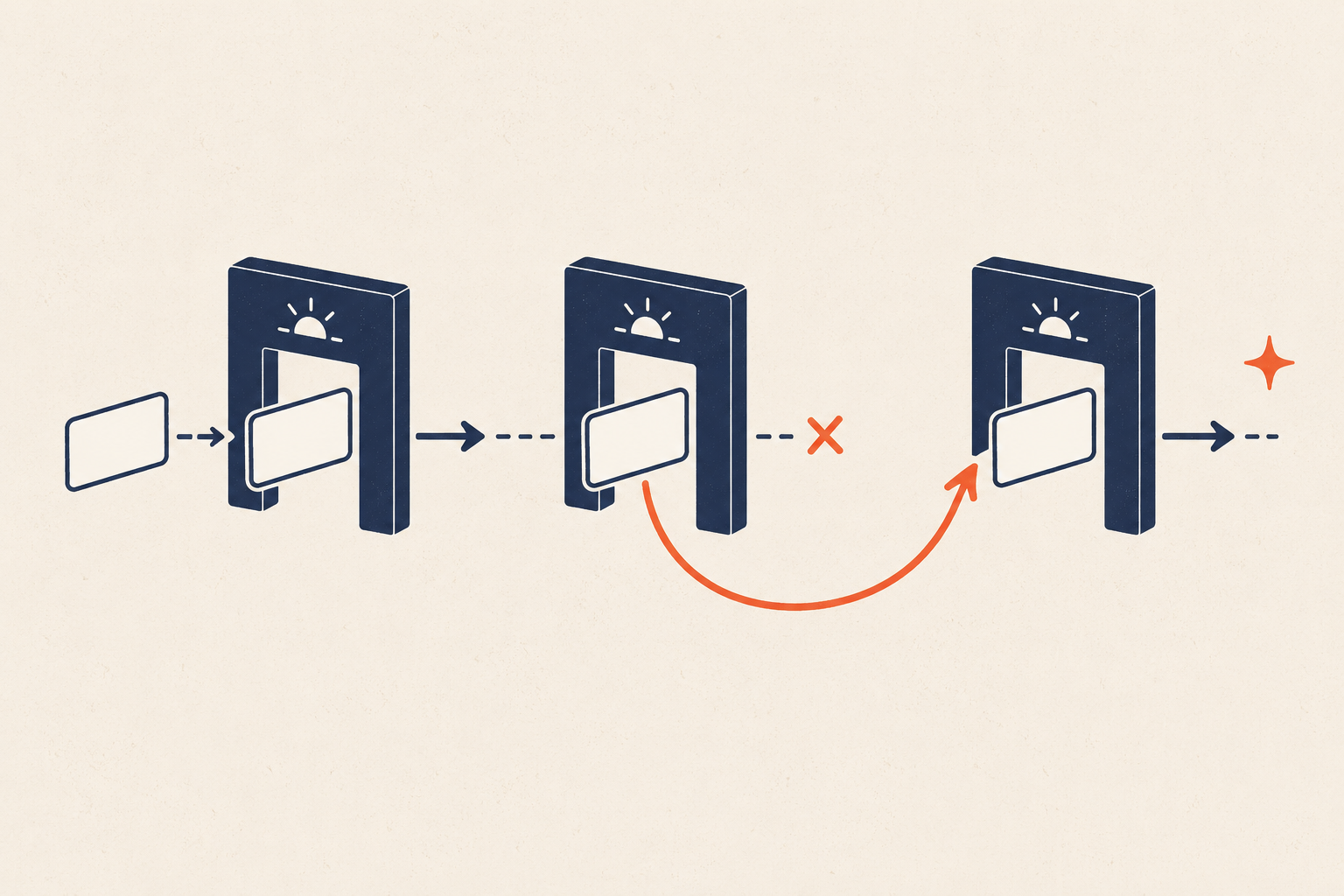
A habit is a response that becomes easier to start in a familiar situation. It is not a personality upgrade, a perfect streak, or proof that you want a goal badly enough.
That distinction makes habit building more practical. You do not have to redesign your identity or follow a universal morning routine. You need one worthwhile behavior, a context you can recognize, and enough workable repetitions for the cue and action to become associated.
Research does not support a magic number of days. A 2024 systematic review of health-related habit formation found substantial variation between behaviors and people, and it noted that the evidence base is still limited. Use repetition as an experiment, not a countdown.
System plate 01 — The test
A useful habit becomes easier to begin in a recurring context and still serves the outcome you chose. It does not need to run perfectly or entirely without thought.
Habit, routine, and goal are different tools
A goal describes an outcome: submit the application, walk more often, or keep the kitchen ready for breakfast.
A routine is a deliberate sequence: check tomorrow’s calendar, pack a bag, and put keys by the door.
A habit is a learned cue-response relationship. Encountering a familiar context makes the action more likely or easier to start. The action may be tiny—putting a glass by the kettle—or it may initiate a longer routine.
The terms overlap, but they solve different problems. A goal supplies direction. A routine coordinates several actions. A habit reduces the need to decide how one repeatable action begins.
This is why “be more organized” is not a habit. “After I place my dinner plate in the sink, I check tomorrow’s first appointment” can become one.
Choose one behavior small enough to repeat
Start with a behavior you can observe. “Read more” is open to interpretation. “Read one page after I sit on the train” has a visible start and finish.
The smallest version should still count as the behavior—not as preparation for a grander version. Opening a document may help you begin writing, but it is not writing. A small complete action might be “write one sentence in the project document.”
Use this four-part definition:
| Part | Question | Example |
|---|---|---|
| Behavior | What will I physically do? | Write one sentence in the project document |
| Context | When or where will the opportunity appear? | After I set down my first drink at the desk |
| Completion | What observable fact means it happened? | One new sentence is saved |
| Purpose | What useful outcome should this support? | Make the project easier to re-enter |
Choose a version that fits an ordinary low-energy day. You can continue after completing it, but extra work is optional. Keeping the floor small protects repetition from becoming another oversized project.
Attach the behavior to a stable context
Habits develop through repetition in context. The cue can include a place, preceding event, time of day, object, or person. “After I brush my teeth” is an event cue; “when I enter the kitchen after work” combines event and place.
A six-week study of student study habits found that greater context stability was associated with greater self-reported automaticity and goal attainment. The authors also described important limits: the student sample was narrow, participants were working inside a study, and reminders were not fully controlled. The result supports a useful design principle—not a guarantee. Read the open-access context-stability study for the full methods and limitations.
Choose a cue that already occurs and is easy to notice. Good candidates include:
- finishing an existing activity;
- entering a particular location;
- placing or using a familiar object; or
- receiving a reminder you can act on immediately.
Avoid attaching a new behavior to something that is itself unreliable. “After my workout, I review my budget” will not help if the workout is the routine you are still trying to establish.
If your schedule changes often, use an event cue instead of an exact clock time. “After the last meeting of my workday” may survive variation better than “at 5:00 p.m.”
Write a cue-action plan
An implementation intention is an if–then plan that connects a recognizable situation with a response: If this situation occurs, then I will do this behavior.
For example:
If I put my lunch container in the sink, then I will refill it for tomorrow.
Research on if–then planning spans many behaviors and populations. Effects vary, and a plan does not remove practical barriers, but meta-analytic work supports it as a useful way to translate an intention into action. A review of implementation-intention research explains the mechanism and the range of observed effects.
Write one main plan and one predictable exception:
- Main: If I close my laptop at the end of work, then I will write the next visible action on a note.
- Exception: If I have to leave suddenly, then I will dictate the next action before I enter transit.
The exception should preserve the function without pretending every day has the same conditions.
Reduce friction before adding motivation
Friction is anything that makes the behavior harder to begin: missing materials, too many steps, an unclear location, a login you cannot remember, or a choice that must be made at the last second.
Run a rehearsal once. Start at the cue and attempt the behavior. Notice the first point where you pause.
Then remove one obstacle:
- put the needed object at the point of use;
- leave the correct document bookmarked;
- decide the first step during the previous session;
- prepare a smaller version for constrained days; or
- move a competing cue out of sight.
Do not engineer the whole environment at once. The test is whether one change makes the next repetition easier.
This is also where format matters. A paper checklist may be visible at the right location; a digital reminder may travel with you and recur automatically. The digital-versus-paper guide helps choose by the job the tool must perform rather than by aesthetic preference.
Make completion observable without worshipping a streak
Tracking is useful when it answers a design question. For the first two weeks, record only:
- whether the cue appeared;
- whether you completed the smallest version;
- what blocked the action, if anything; and
- whether the behavior produced the intended result.
A check mark can show repetition, but it cannot tell you why the action failed or whether it remains useful. Add a short friction note when needed: “materials upstairs,” “cue happened too late,” or “action took 20 minutes, not five.”
Do not turn the record into a verdict. A long streak can preserve a behavior that no longer serves you. A missed day can reveal a changed schedule or a poor cue.
Treat a lapse as information
One missed opportunity does not require a restart ceremony. At the next cue, perform the smallest complete version.
If you miss several opportunities, use this recovery sequence:
- Find the last working repetition. Where were you, and what had just happened?
- Name the change. Did the cue disappear, the behavior grow, or current capacity fall?
- Restore the smallest version. Remove optional steps for the next three opportunities.
- Choose a current cue. Do not keep waiting for an old schedule to return.
- Review after three attempts. Keep, adjust, or retire the behavior.
The point is re-entry, not catching up. Habits do not accumulate debt.
If recurring lapses reflect an overloaded plan rather than a poor cue, fix the workload instead of tightening the tracker. The sustainable productivity guide shows how to add capacity limits, slack, and a reduced operating mode.
You can use a short timed session when the action is bounded; the Pomodoro guide explains that method. Use a timer as a start boundary, not as evidence that every useful behavior should run in 25-minute intervals.
Review whether automaticity is useful here
Not every action should become automatic. Some decisions deserve attention because conditions, risks, or values change.
Ask four questions after two to four weeks:
- Does the context occur often enough to support the behavior?
- Is the action easier to begin than it was at the start?
- Does the behavior still produce a useful result?
- Would automatic repetition create any downside?
Keep the habit if it reliably removes a small recurring decision. Adapt it if the cue is unstable or the action is too large. Retire it if the outcome no longer matters.
A weekly review is a good place to inspect habits without managing them every day. If you already use Getting Things Done, the beginner’s GTD guide shows where that review fits. A habit can support a system, but it cannot replace the decisions and maintenance the wider system requires.
A seven-day habit field test
Use this compact experiment:
- Name one observable behavior.
- Choose a cue that already occurs.
- Write the main if–then plan.
- Prepare the materials at the point of use.
- Define a smaller low-capacity version.
- Record cue, completion, and friction for seven days.
- Change one design element based on what happened.
At the end, do not ask whether you are “a habit person.” Ask whether the cue was visible, the action was feasible, and the result was worth repeating. Those are conditions you can work with.